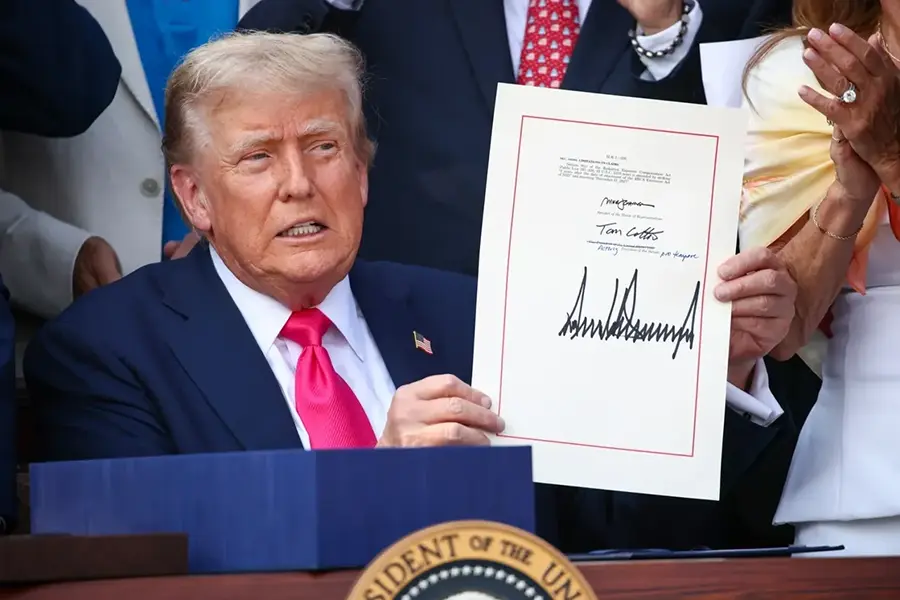
Last Friday, during a Fourth of July celebration, President Trump signed the “One Big, Beautiful Bill” (“OBBB”) into law. The OBBB is the most sweeping tax and spending package to go into effect since 2017.
The new law makes the tax cuts from the Tax Cuts and Jobs Act permanent and provides extensive benefits to families, workers, homeowners and small business owners. However, in order to fund these benefits, the OBBB makes deep cuts to Medicaid, SNAP (food assistance programs), student loans and clean energy programs.
What Changes Are in the OBBB?
The Good
The OBBB permanently extends major tax cuts from the 2017 Tax Cuts and Jobs Act—locking in lower rates and deductions for families—while introducing new tax breaks including no federal income tax on tips and overtime pay, a senior citizen deduction, and an expanded child tax credit. It also raises the SALT deduction cap to $40,000 temporarily, keeps taxes off Social Security benefits, provides deductions for certain auto-loan interest, excludes certain tips and overtime pay from income, and supports infrastructure like air traffic control modernization and the missile defense systems.
The Bad
The bill offsets these tax cuts with over $1 trillion in spending reductions, primarily effected through imposing work requirements, eligibility checks, and tighter provider taxes on the Medicaid and SNAP programs, as well as by adding an excise tax on certain international remittances and drastically reducing benefits for many clean energy technologies. Even with these cuts the OBBB is projected to adds trillions to the national debt. Furthermore, the OBBB has also attracted significant controversy byallocating significant funding to border enforcement, defense, and deportations.
Given the balance of benefits and detractions of the OBBB, the legislation benefits some and hurts others. The following sections explain who the bill helps and hurts.
Who Do These Changes Help?
The OBBB provides large benefits for most people through:
· An extension of the rate cuts created by the Tax Cuts and Jobs Act in 2017
· The increase of the standard deduction amount for the tax year ending in 2025 to $30,000 for joint filers and surviving spouses; $22,500 for heads of household; and $15,000 for single individuals and marrieds filing separately (with further inflation adjustments for subsequent tax years), and
· A deduction for auto loan interest.
The OBBB also provides additional benefits targeted toward specific categories of persons, such as families, employed persons, homeowners, small business owners and senior citizens.
· Families benefit from the OBBB by receiving a larger child tax credit, the implementation and funding of “Trump Accounts”, the expansion of qualified expenses for 529 accounts, an increase to estate tax thresholds, and indirectly through certain benefits paid to employers
· Employed Persons are primarily benefitted by provisions excluding tax on overtime pay and tips
· Homeowners are primarily benefitted through the increase of the State and Local Tax Deduction
· Small Business Owners receive benefits in the form of continued passthrough deductions and bonus expensing
· Seniors receive benefits through a new deduction and an increased standard deduction amount
Upcoming Articles will explain how the OBBB helps each of these groups in greater depth and what steps should be taken to ensure use of each of these benefits.
Who Do These Changes Hurt
On the other hand, the OBBB hurts several groups of people, notably recipients of public benefits, immigrants (both “legal” and “illegal”), and recipients of clean energy benefits.
Public Benefits Recipients
The OBBB negatively affects low-income beneficiaries of public. Persons who rely on public assistance programs like Medicaid, SNAP (food stamps), and housing aid, by imposing strict work requirements, documentation rules, and deep funding cuts to these programs, which could lead losing access to essential healthcare, food support and housing.
Immigrants
Furthermore, the OBBB affects significantly affects immigrants to the United States. The OBBB allocates significant funding to border enforcement and deportations, and expands immigration controls. Even “legal” immigrants, such as green card holders and visa residents must face increased documentation checks, residency verifications, and sometimes work requirements, which can lead to delays, denials, or discouragement from applying for further status adjustments or public benefits program—even if they are technically eligible.
Moreover, the OBBB introduces new feesand stricter scrutiny for visa renewals, green card processing, and family-based sponsorships. Some legal pathways are slowed or narrowed, especially for extended family members. Employment-based applicants may benefit slightly from merit-based shifts, but family-based immigrationbecomes more constrained.
Furthermore, “legal” immigrants often do not benefitfrom many of the bill’s tax relief provisions—such as the exclusion of tax on some tips—if they are not classified as U.S. taxpayers. Some may gain from the expanded child tax creditor deductions if they meet IRS residency tests, but eligibility can be inconsistent and complex.
In short, immigrants may find themselves subject to increased scrutiny, navigating more paperwork, fewer benefits, and reduced family unification options, and will be largely excluded from the OBBB’s newly introduced tax benefits.
Beneficiaries of Clean Energy Benefits
The OBBB ends or phases out many clean energy tax credits, including those for electric vehicles (EVs), solar and wind projects, and EV charging stations, making clean tech purchases and installations more expensive for consumers and less attractive to investors.
The also imposes new limits on clean energy projects using components from foreign “countries of concern”, like China. These restrictions are likely to disrupt clean energy supply chains an increase the prices of clean energy components and technology for businesses and consumers.
Upcoming Articles will explain how the OBBB hurts each of these groups in greater depth and will introduce some solutions for reducing the impact of the OBBB on these groups.
When Do These Changes Go into Effect?
On July 4, 2025 (the date that Trump signed the OBBB into law), several of the OBBB’s provisions immediately went into effect, including:
· Tax bracket extensions, larger standard deduction, permanent pass-through deduction, no federal income tax on tips or overtime pay
· Border/security and ICE funding kicks in immediately, including new detention beds and hires
· Clean energy tax credit phase-outs begin with EV credits expiring by Sept 2025
· The SALT deduction is effective for tax years 2025–2029
· Senior deduction is effective for tax years 2025–2028
· Trump Accounts: grants for newborns begin July 2025; while contributions are scheduled to be allowed for tax years 2025–2028.
Other provisions of the OBBB are subject to “phase in” that cause their implementation to occur gradually, including:
· Tip and overtime income deduction becoming effective on January 1, 2026 and lasting through 2028
· Medicare automatic cuts and Medicaid work and documentation mandates beginning in 2026
· Medicaid work requirements begin in 2027
· Solar and Wind project credits require construction to begin by June 2026 or projects to be placed in service by December 2027
· Estate-tax exemption increase becomes effective beginning in the 2026 tax year
This is Part 1 of a several part series of the OBBB. In the upcoming weeks I will provide additional coverage and analysis of the OBBB, including detailed breakdowns of how to access the benefits it provides and how to mitigate several of its harsher effects.